
Green Tiger Markets: February Electricity Market Review

Dear Valued Client,
First, a heartfelt thank you to the ERC for welcoming the GTM team to share our training session, “Financial Hedging and Energy Forward Markets.” Together, we explored how hedging strategies, contracts-for-difference, and liberalized power markets are reshaping energy risk management across the globe. We’re excited to build on this momentum in future collaborations—and we hope the live trading simulation was as insightful and energizing for you as it was for us.

First, a sincere thank‑you to every participant and supporter—your commitment is the engine behind Green Tiger Markets’ momentum. Because of your activity, we’re seeing real depth build in our books, bid‑offer spreads tightening, and matching becoming more consistent month after month. In short, liquidity is coming of age on the platform, making hedging not only easier to execute, but more powerful and effective for everyone at the table.
February didn’t just keep the pace—it accelerated it. Participation from both buyers and sellers remained robust, and interest along the 2026 curve stayed firmly anchored. We’re now seeing more deliberate, strategic positioning as participants move to secure price certainty and lock in stability ahead of what many expect could be a more turbulent period in global markets.
The recent escalation in tensions between Iran and the United States has unsettled energy markets worldwide, lifting crude and LNG prices and raising questions about future fuel costs for thermal generation. While it’s too early to tell how directly these developments will feed into Philippine power prices, they serve as a timely reminder of how intertwined our market has become with global energy dynamics and more importantly... The need for hedging.
Against that backdrop, GTM continues to provide a transparent, neutral venue where participants can manage exposure and protect value—even as the external environment grows more uncertain. In this month’s review, we’ll take a closer look at evolving market action and pricing trends. And how hedging activity is helping to create stability amid global volatility.
Interested in learning more about how to improve supply/demand balance forecasting?
Areas of Focus for Hedging
Forward prices were drifting lower during February
The sellers disappeared after the Iran conflict got underway
1 year baseload strips starting over the next few months have been in the low 4s.
Strong desire to sell Midday hours
April 1 year: 4250 Bid @ 4600 Offered
April for 2 years 4000 Bid @ 4300 Offered
Cal 27 4100 Bid @ 4500 Offered
Long term Baseload (5 years or more) 4000 value.
Renewed interest in Visayas hedging
We continue to see a strong and sustained rise in activity from a wide range of participants who are eager to lock in prices for next year and beyond. This includes both long-standing counterparties increasing their volumes and a growing cohort of newcomers who are keen to secure certainty in an increasingly volatile market. Over the last few months, we’ve onboarded a significant number of new clients, and they are quickly moving from initial exploration to active execution—requesting live quotes, engaging on structured strategies, and taking advantage of current forward levels to secure their positions ahead of future moves.
Live pricing levels:
With prices moving quickly and opportunities opening and closing by the day, the most effective way to see what’s truly available is to speak with us directly. Get in touch for a live, up-to-the-minute view of active orders and tailored opportunities so you can move first—not follow.
Meet with a GTM Risk Management Specialist
In a quick phone call we can help stabilize your future.
Market Data and Commentary
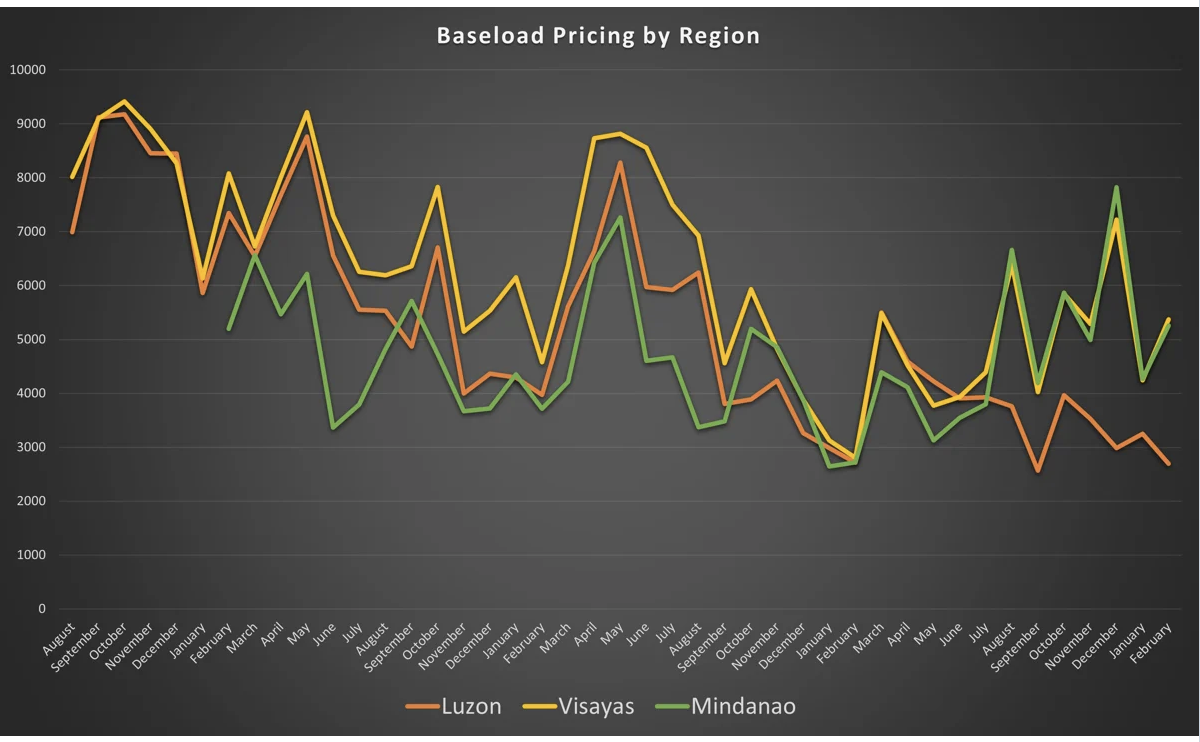
#1 Baseload Prices by Region
In February 2026, Luzon spot prices eased, as healthier supply margins and seasonally lower demand delivered welcome relief on many customer bills. In contrast, Visayas and Mindanao continued to face comparatively tighter conditions, with ongoing grid reliability challenges driving a clear and growing divergence from Luzon over the past several months.
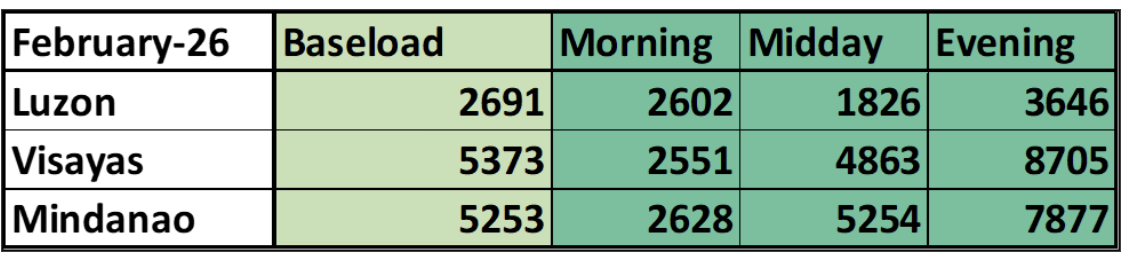
February saw fairly steady prices throughout the month in Luzon with very little impact from outages. Final prices came in at 2.69 php/kwh, below Jan 2025's clearing price of 3.25 php/kwh.
Prices in Visayas and Mindanao were substantially higher than Luzon for this billing period though not as dramatic as the December pricing window. We will be keeping a watch on VisMin to see if it converges to Luzon again soon.
Our early look has March Luzon Baseload coming in around 4.5 php/kwh well below last year's levels. Visayas has been drifting down towards Luzon prices and Mindanao has been soft.
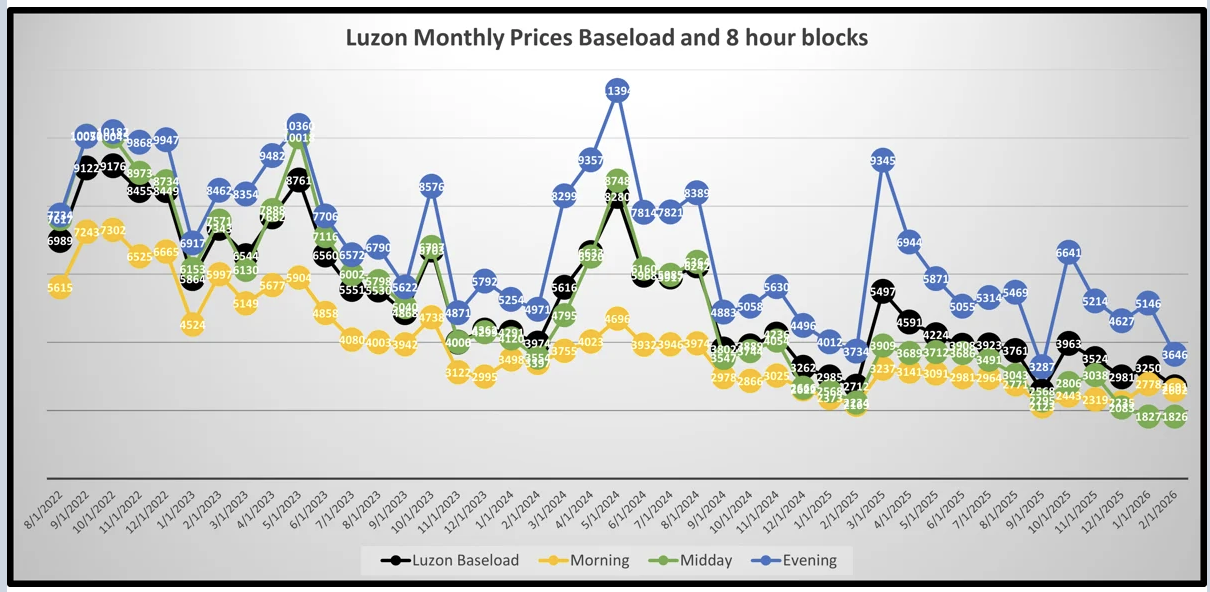
#2 Luzon prices by 8hr time block
In our second graph below, we have plotted the 8 hour time block contracts as well as Baseload.
Midday Hours continue dislocating lower on occasion, with steady repricing for the Midday Hours to match or even go under Morning Hours.
Evening hours could see upward pressure as demand starts to increase, and hydro output declines.
Midday, however, continues to average well under Baseload in Luzon. February 1 saw Midday print well under zero, around -3.5php/kwh. We continue to expect this to become a more regular occurrence. We expect Midday to continue deteriorate given the supply situation with new solar facilities continue to get energized. several GW are slated to come before year end. It will be something to watch carefully.
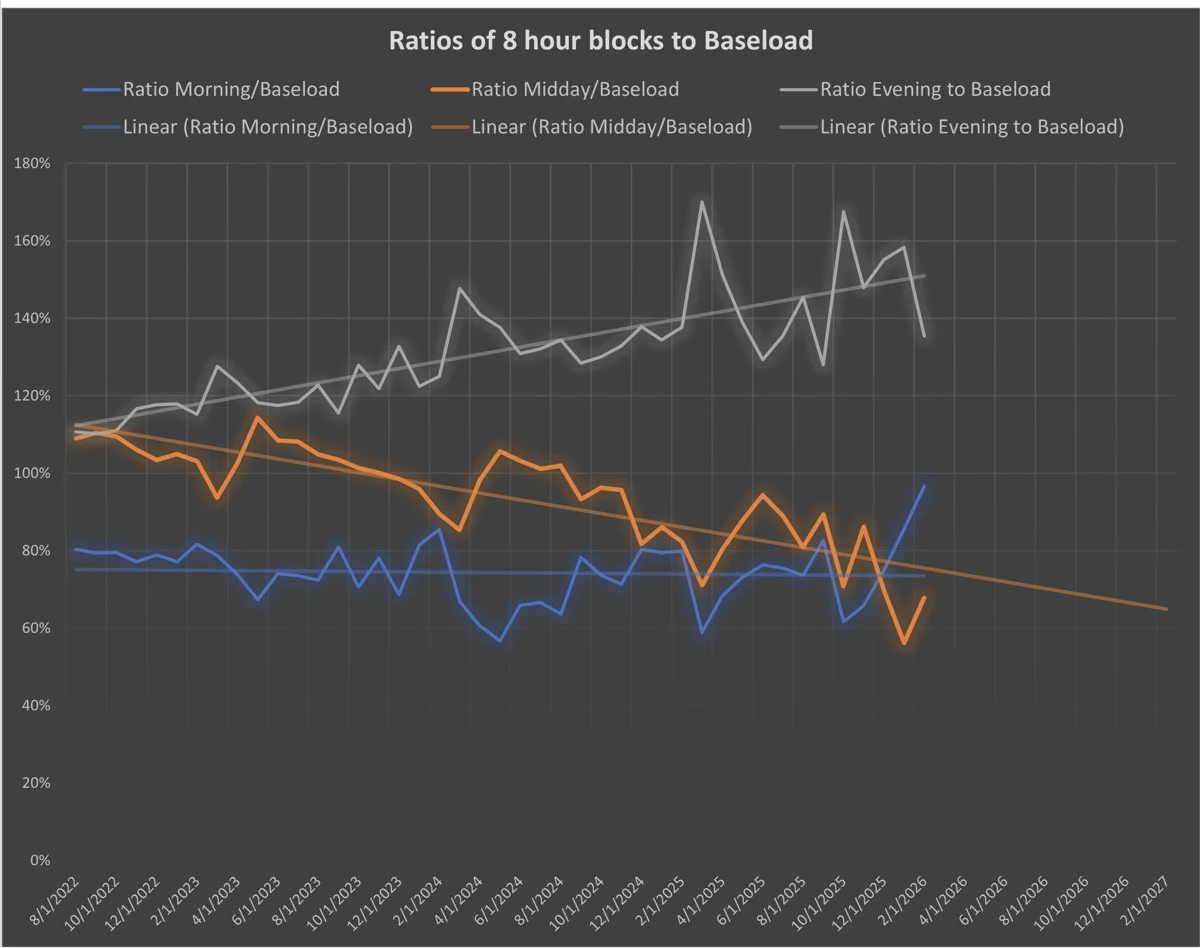
#3 Luzon monthly ratios by product
In our third graph below, we have plotted the ratios of the individual 8 hour products to Baseload.
The Evening Hours softened in February relative to baseload. Midday and Morning Hours continue to be weak relative to baseload but showed a little life. We saw Evening Hours prices clear roughly 35% over baseload for February. Morning hours are running roughly 20% below baseload with Midday leading the way lower. Low overall prices made for fewer upside opportunities in spot pricing.
This month saw the second full billing period where Midday priced below Morning in Luzon.
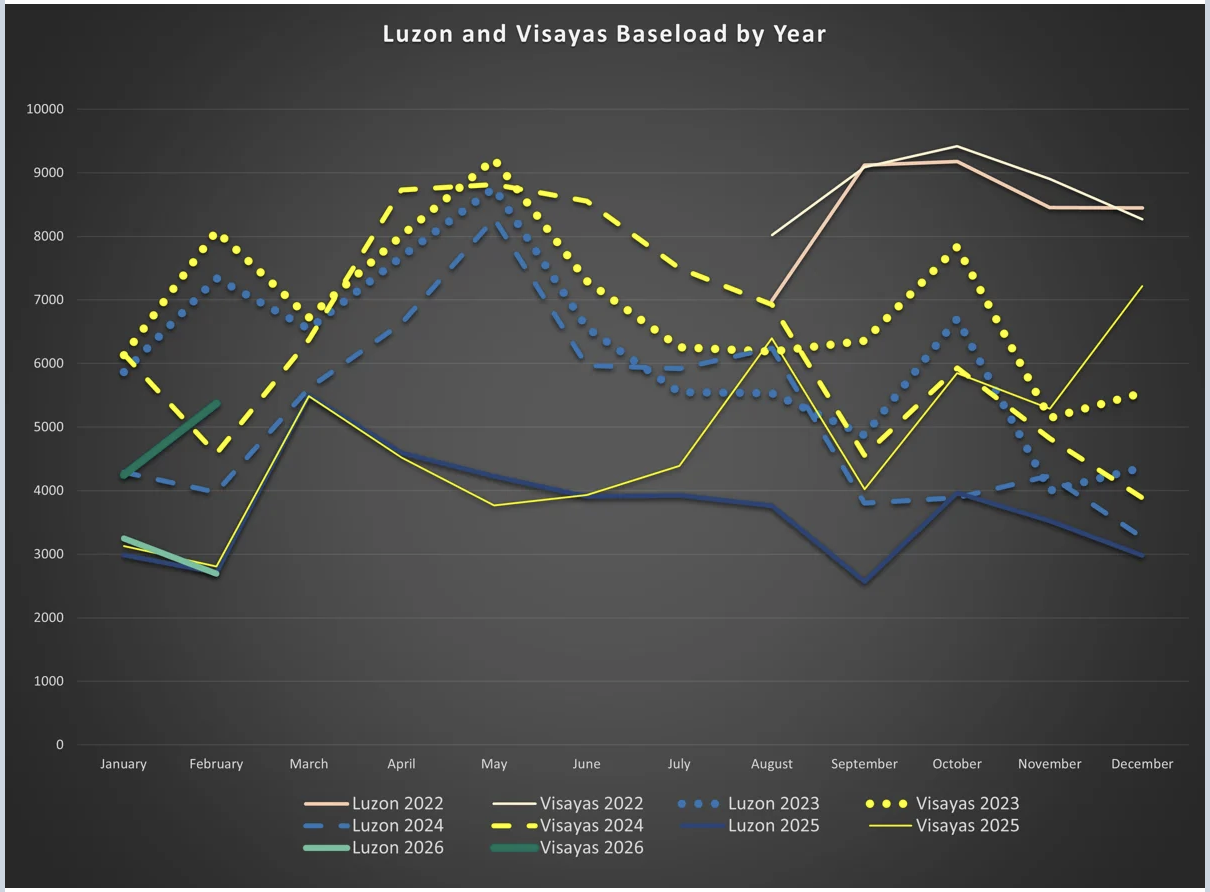
#4 Luzon and Visayas Baseload by year
For Luzon, 2025 was bearish when compared to the previous few years. 2026 is starting out roughly similar to where last year cleared. We are anxiously waiting to see where this year comes out with all of the new Solar gen scheduled to come to market.
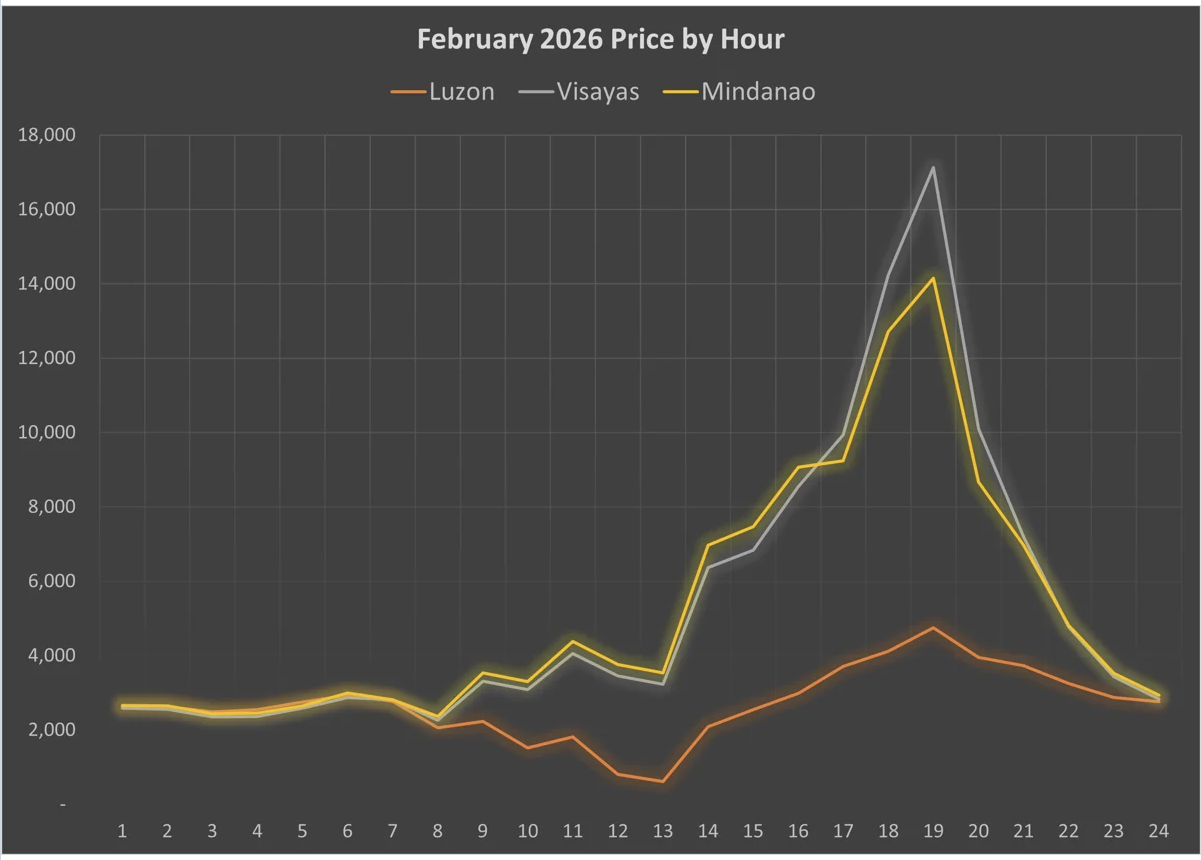
#5 Hourly Prices by Region
Below we have plotted hourly prices by region. Note the massive gap that opened up during Midday and Evening hours in Visayas and Mindanao vs Luzon for the past month. As more solar comes in, we expect to see more subdued midday pricing, but it could take some time. Solar penetration in Mindanao is demonstrably lower, as a percentage of the stack, compared to Luzon, so we would expect midday prices to stay strong down South.
If you are interested in learning more about our data analysis, please don't hesitate to contact us at [email protected].
New Market Participants!
We continue to add market participants and expand the number of approved counterparties for the GTM market.
As a reminder, all market participants must have net assets in excess of SGD$10mm to become approved market participants.
Market News
As per our usual practice, we have incorporated a selection of recent news stories and emerging trends in the PH electricity market. If there are any noteworthy events you would like us to share, kindly inform us! Enjoy!

How the Iran conflict is hitting global prices:
Please see our latest piece on the conflict's impact on energy prices. TLDR, expect baseload to finish between 2024 and 2025 prices.

ERC holds staff training on financial hedging tools:
The ERC conducted a specialized training session for its personnel, lead by Green Tiger Markets, aiming to equip staff with knowledge to address electricity price volatility and protect consumers from sudden bill increases.
MGEN says its fuel supply is sufficient despite Middle East tensions:
MGEN assured that it currently has adequate fuel supply for all of its existing generation facilities.

Prime Infra secures PHP 273 billion financing for 2-GW pumped storage projects:
The funding deal will finance two pumped storage projects in Laguna and Rizal that are expected to strengthen grid stability and support the country’s advancing renewable energy transition.

Marcos certifies fuel excise tax suspension bill as urgent:
Authority to temporarily suspend or reduce excise taxes on petroleum products amid rising global oil prices

Semirara profit falls 33% in 2025 amidst declining coal and electricity prices:
The average electricity selling price declined 8% to PHP 4.38 per kWh, from PHP 4.75 per kWh, reflecting increased sales into WESM.
ACEN profits plunge 60% in 2025 amid market headwinds:
Net income tumbled 60% to PHP 3.8 billion in 2025, weighed down by offline wind assets in Northern Luzon, weaker solar irradiance, and softer spot market prices.
Aboitiz Power Corp.’s reported net income fell 43% to PHP 19.5 billion in 2025:
Despite the drop in reported profit, AboitizPower’s operating performance improved in 2025, with EBITDA rising 9% in 2025 vs 2024.
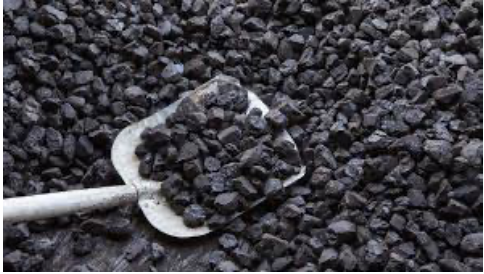
Coal price outlook:
Newcastle coal futures are around $130/ton and looking to head higher.
Joining the GTM Marketplace is free.
We highly encourage you to connect with other potential participants who haven't yet joined this thriving marketplace. It's an incredibly efficient way to enhance the liquidity on Green Tiger Markets. If there's a specific company you believe would be a valuable addition to our marketplace, introducing them warmly can truly make a significant impact.
Stay safe and thank you for your business!
-John Knorring, CEO Green Tiger Markets
The views contained in this newsletter are my own opinion and should not be considered investment advice or relied upon to make investment decisions. Disclaimer.
